Monday, 12 January 2015

The most important part of all......FOOD!!

The essence of Italian cooking today is simplicity. One uses the freshest seasonal ingredients possible, and then uses basic cooking techniques to simply enhance the natural flavor of the food. Italian food is a surprisingly diverse cuisine. Each of the twenty Italian regions has a distinctive set of flavors, recipes, products, and ingredients.  In fact, the Italian regions were not officially united as a nation until the mid-19th century; therefore, each individual region has retained much of its exclusive identity.

Climate and natural landscape have played a major role in shaping regional cuisines. Creamy risotto and other delicately flavored dishes predominate in the Northern regions, while bright olive oil and tomato-based recipes rule the sunny South. Beef is best enjoyed as Florentine steaks in Tuscany, from choice cattle raised in the Chianina Valley. 


Italy is one of the largest wine producers in the world with a broad span of both white and red varietals. Yet the Sangiovese varietal, originating in Tuscany, is arguably Italy’s winemaking claim to fame. Derived from the words “sanguis Jovis” or “blood of Jobe,” this red wine grape is the main grape in Chianti and Brunello wines.


And of course, who hasn't heard about the cheese from Italy. Cheeses range from the soft, mild Buffalo Mozzarella of Campania to the hard, salty Pecorino Romano of Sardinia. They often carry names indicative of their origins, such as the increasingly popular Grana Padano (a “grainy” cheese from the “Padana” or Po Valley of the Lombardy region).a

Did you know, that location is so important to many Italian food products that laws exist to protect the authenticity of products made in a certain region. For example, any vinegar labeled Modena Balsamic vinegar must be crafted in the town of Modena, and any cheese labeled Parmigiano Reggiano must be produced in one of several provinces in Emilia-Romagna.


One of the most common dishes of the Italian Cuisine is pasta.  But even this pasta is unique from place to place. Fresh homemade pasta abounds throughout Italy and is often simply dressed, so as not to overwhelm its delicate flavor. Dried pasta is most popular in the South and can be adorned in countless inventive ways. Some say there are more pasta shapes in Italy than one person could conceivably eat in a lifetime. Italians have been known to squabble over the proper name and culinary use of a particular pasta shape. Some shapes have legends behind their creation, such as tortellini, from Emilia-Romagna. Legend has it that a lusty innkeeper in the city of Bologna invented this ring-shaped, stuffed pasta after peeping on the goddess Venus through a keyhole. With merely a glimpse of her bellybutton, he ran straight to the kitchen in a fit of passion to make this pasta in honor of her bewitching navel.
Italian food is always a matter of regional pride. But if one were to try and sum up this diverse cuisine,  Italian cooking can best be described as a celebration of local flavors held together by a singular appreciation of high-quality, seasonal ingredients, presented in elegant simplicity. Across all regions, Italian dishes are straightforward preparations of a few choice ingredients, which are artfully combined. Italy is unified by a national concept of classic meal structure. Rather than serving up everything in one or two courses, Italian dinners traditionally include an array of many small plates enjoyed in succession, giving diners an extended time to savor food and company. Meals progress from antipasto (appetizer), to a first course of pasta or other starches, a main dish of meat or fish with a simple side of vegetables, followed by salad, cheese and fruit, coffee, and possibly a digestive (like grappa or sambuca liquor). Contemporary city dwellers, who have largely abandoned this meal structure for convenience sake, often still follow it on holidays, when the long feast still prevails. Yet these time-consuming meals arguably inform the Italian understanding of food as a sensory bliss beyond mere nourishment.
Dessert is sometimes served at the end of a special meal, but more often is enjoyed on its own as a midday snack. Characteristically, Italian dolci are restrained in terms of sweetness. Cookies, cakes, pastries, and tarts can be savored with coffee as a daytime energy boost..

The ever-popular tiramisu literally means “pick me up” and is composed of sweetened mascarpone and Marsala with espresso-soaked lady fingers. One theory asserts that Northern Italian women created this caffeinated dessert to stimulate and fortify troops during World War I. Some sweets are more specific to holiday seasons, such as panettone, a buttery egg bread laced with dried fruit and candied citrus, eaten around Christmas. This famous Milanese treat is quite laborious to make, traditionally taking up to a week to complete.


Gelato is a popular year-round dessert. This rich, intensely flavored Italian ice cream can be enjoyed anywhere at any time. The most exceptional Italian contribution to the field of pastry is probably the Piedmontese invention of gianduja (a sweet chocolate containing 50% hazelnut paste). Gianduja is used as an ingredient in innovative desserts throughout the world. It even inspired the creation of Nutella, one of Italy’s many popular food exports.

Coffee, particularly espresso, enjoys widespread popularity and cultural significance throughout Italian cities. The vast range of espresso drinks served in Italian cafes has been mimicked in coffee houses throughout much of the world. Luigi Bezzera filed the first patent for cappuccino in 1901, deriving its name from this foamy drink’s resemblance to the brown and white hooded garments worn by Capuchin monks. Espresso was first developed in Milan in the early 20th century, although the modern espresso machine did not appear until the mid-1940s. Many people misunderstand the term espresso. Rather than referring to a specific style of coffee bean or roast, espresso is simply a thicker, concentrated extraction of coffee through a highly pressurized brewing process. The barista, responsible for preparing espresso drinks in cafes, is a highly regarded career position in Italy. Busy urbanites rely on local baristas for a delicious pick-me-up at various times of day.
Street foods, such as gelato and panini sandwiches, are also popular in the hectic metropolitan cities. But no street food is as ubiquitous in Italy as pizza. Despite pizza’s global status, most international pizzas bear little resemblance to the thin, crunchy crusts invented in Naples. Served with only a minimal topping of garlic and herbs or fresh mozzarella and basil on sparsely smeared tomato sauce, this tasty, wood-fired bread has a distinctive flavor. The tomato sauce, garlic, herb variety, called Pizza Marinara, is said to be the oldest variety of pizza, and was named for a Neapolitan fisherman who often enjoyed this dish. Baker Raffaele Esposito created another variety, Pizza Margherita, in honor of Queen Margherita, using red sauce, white mozzarella, and green basil to represent the Italian flag. This queen, who could appreciate the splendor of workingman’s food, subsequently rose in the esteem of her people.
A somewhat wider variety of pizzas can be found throughout Italy today.
Nevertheless, the classic Naples pizza remains a perfect symbol of the beautiful simplicity intrinsic in Italian cuisine: the clever uncomplicated preparation of a few delicious ingredients to render a truly world-class dish that is at once humble and supremely epicurean.
When you're in Italy, we suggest stepping out of your culinary comfort zone to try all (or almost all) the country has to offer. Here is a guide to the basics. When it fails, your best bet is to order what the guy next to you is having – “prendo quello che ha preso lui.” 

At the coffee bar
    • Caffè – an espresso
    • Cappuccino – a breakfast beverage not to be ordered after lunch or dinner 
    • Macchiato – an espresso “stained” with milk foam                                                                                                                                               
At the pizzeria

  • Pizza – a flatbread, often circular in shape, baked with or without toppings
    • Mozzarella – cow’s milk cheese made by pulling or stretching the warm curd
    • Peperoni – bell peppers


At the gelateria
  • Fiordilatte  - “the flower of milk,” theoretically made with the best part of the milk, meaning the cream
  • Panna – cream made without egg yolk
  • Crema – cream made with egg yolk
  • Cioccolato – chocolate
At the paninoteca 
  • Panino – an Italian sandwich
  • Panini – more than one Italian sandwich. Panini is plural. 


At the salumeria  


  • Prosciutto di Parma – salt-cured, air-dried ham, aged in or around Parma for months.
  • Prosciutto San Daniele – salt-cured, air-dried ham from San Daniele in the Friuli region of Northeastern Italy
Good to know
  • Colazione – breakfast
  • Pranzo – lunch
  • Cena – dinner
  • Merenda – snack, normally acceptable only if you are under the age of ten
  • Pane – bread
  • Olio extra vergine di oliva – EVOO
  • Formaggio – cheese
Even better to know  
  • “Conosco i miei polli.”
Literally – I know my chicken.
What it means – I know what I am talking about


  • “Sei come il prezzemolo.”

Literally – You are like parsley
What it means – You pop up everywhere.  
  • “Non fare il salame.”
Literally – Don’t act like salame.
What it means – Don’t be a ham, you idiot.
  • “Non tutte le ciambelle riescono col buco.”
Literally - Not all donuts come out with a hole.
What it means – Things don’t always turn out as expected.
  • “Non puoi avere la botte piena e la moglie ubriaca.”
Literally – You can’t have a full wine barrel and a drunk wife.
What it means – You can’t have your cake and eat it too. 
So I guess in Conclusion, what I'm trying to say is that at the end of the day, there really is no other cuisine like Italy's.

BY
Shreya Balaji and Secchione Poindexter


Sunday, 4 January 2015

ITALIANI ISTRUZIONE: An overview to Italian Education System

Children sing Christmas carols during the traditional
Christmas party at a kindergarten in Milan, Italy.
Until now, we have seen the country's Christmas celebrations and the political scenario of the country. Christmas vacations just went by and the ones who looked forward to it the most were children, for that was the prime time they get off from their usual school routine just like any other child in the world in spite of their different education system.
  • "Experience runs a valuable school, but fools learn in no other."
"Virtue comes not from chance but long study."
  • (Italian Proverb)

The education system in Italy is organised according to the subsidiary principle and autonomy of schools. The State has exclusive competence on general issues on education, on minimum standards to be guaranteed throughout the country and on the fundamental principles that Regions should comply with within their competences. Regions share their competences with the State on education issues while they have exclusive competence on vocational education and training. Schools are autonomous as for didactic, organisation and research and development activities. 

The education system is organised as follows: 

  •  Pre‐primary school for children between 3 and 6 years of age;   
  •  
    An elementary school in Aosta Valley,
    with the name both in Italian and French
  • First cycle of education lasting 8 years, made up of:
    1.  Primary education (lasting 5 years), for children between 6 and 11 years of age;   
    2. Lower secondary school (lasting 3 years) for children between 11 and 14 years of age;   
  • Second cycle of education offering two different pathways: 
A high school in Palermo, the Liceo classico
Vittorio Emanuele II, right next a cathedral
    1. State upper secondary school (lasting 5 years) for students from 14 to 19 years of age. It is offered by licei, technical institutes and vocational institutes;   
    2. Three and four‐year vocational training courses (IFP) addressed to students who have completed the first cycle of education. It is organized by the Regions.   
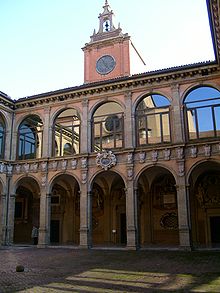
University of Bologna, Italy and Europe's
oldest university, founded in 1088
  • Post‐secondary non tertiary education offered through: post‐qualification and post‐ diploma vocational courses organized by the Regions; Higher technical education and training courses (IFTS).   
  • Higher education offered by universities and the High level arts and music education system (Afam). Higher education is organised in first, second and third levels according to the Bologna structure. 
Education is compulsory for 10 years, from 6 to 16 years of age, and covers the eight‐year first cycle of education (5 years of primary school and 3 years of lower secondary school) and the first two years of the second cycle (DM 139/2007). After completion of the first cycle of education, the last two years of compulsory education (from 14 to 16 years of age) can be accomplished either in State upper secondary schools (licei, technical institutes and vocational institutes), or through the three‐year vocational education and training courses, falling under the competence of the Regions (law 133/2008).  
In addition, all have the right/duty (diritto/dovere) to education and training for at least 12 years in the education system or, anyhow, until they have obtained a three‐year vocational qualification within 18 years of age (law 53/2003).

Finally, 15‐year olds can attend the last year of compulsory education also through the apprenticeship, previous specific agreement signed by the Regions, the Ministry of labour, the Ministry of education and trade unions (law 183/2010). 

STRUCTURE OF THE ITALIAN EDUCATION SYSTEM
Compulsory education refers to both enrolment and attendance. It can be accomplished either in a State and a paritaria school and also, at certain conditions, though parental education and merely private schools; regional three‐year vocational training courses are offered by the relevant training agencies. Parents or caregivers are responsible for the accomplishment of compulsory education, while supervision on the fulfilment of compulsory education falls under the responsibilities of local authorities where pupils reside and school heads of the schools pupils are enrolled in. 

Once compulsory schooling has been accomplished, pupils who don’t prosecute their studies receive a certification attesting compulsory education fulfilment and competencies acquired; these latter constitute formative credits for the attainment of any professional qualification. 

Access to both university and Afam tertiary education is reserved for students who passed the State exam at the end of upper secondary school. Yet, specific conditions for the admission are under the responsibility of the Ministry of education, University and Research (MIUR) or of each single university and Afam sector. 
The first italian graduates from the HERMES
Dual degree program between Ca Foscari and EM Strasbourg
The three‐year vocational qualification, as well as the four‐year vocational diploma, both obtained at completion of regional vocational training courses, allow access to regional second level vocational training, which can be access also with an upper secondary education leaving certificate. This latter certificate also grants admission to Higher technical education and training courses (IFTS).

The education system in Italy might seem a bit complex at first, but over time, Italy has been producing some of the finest graduates in the world. 

Friday, 26 December 2014

POLITICAL SCENARIO OF ITALY

 THIS IS A BRIEF DESCRIPTION OF ITALY'S POLITICAL SCENARIO.

The politics of Italy is conducted through a constitutional republic with a multi-party system. Italy has been a democratic republic since June 2, 1946, when the monarchy was abolished by popular referendum .The constitution was written by the Constituent Assembly of Italy and promulgated on January 1, 1948. The executive power is exercised collectively by the Council of Ministers, which is led by the Prime Minister, officially referred to as President of the Council ("Presidente del Consiglio"). Legislative power is vested in the two houses of parliament primarily, and secondarily on the Council of Ministers, which can introduce bills and holds the majority in the parliament. The judiciary is independent of the executive and the legislative branches. It is headed by the High Council of the Judiciary. The President is the head of state, though his position is separate from all branches.

The current President of Italy is Giorgio Napolitano and current Prime Minister of Italy is Matteo Renzi.
MOTTO  OF ITALY:
Italy is a democratic Republic founded on labour. Sovereignty belongs to the people and is exercised by the people in the forms and within the limits of the Constitution.
HEAD OF THE STATE
As the head of state, the President of the Republic represents the unity of the nation and has many of the duties previously given to the king of Italy. The President serves as a point of connection between the three branches: he is elected by the lawmakers, he appoints the executive, and is the president of the judiciary. The president is also commander-in-chief of the armed forces.
The President of the Republic is elected for seven years by Parliament in joint session, together with three representatives of each region, except for the Aosta Valley, which gets only one representative.
The only Presidents ever to be elected on the first ballot are Francesco Cossiga and Carlo Azeglio Ciampi. Mr. Ciampi was replaced by Giorgio Napolitano, who was elected on 10 May 2006. While it is not forbidden by law, no president had ever served two terms, until 20 April 2013, when president Giorgio Napolitano was re-elected


LEGISLATIVE BRANCH
With article 48 of the Constitution, which guarantees the right to vote, the people exercise their power through their elected representatives in the Parliament.The Parliament has a bicameral system, and consists of the Chamber of deputies and the Senate, elected every five years.
The Chamber of deputies is elected by direct and universal suffrage by voters who are eighteen. There are 630 deputies, twelve of which are elected in the overseas constituencies. All voters who are twenty-five on election day are eligible to be deputies.
The Senate is elected by direct and universal suffrage by voters who are twenty-five. There are 315 senators, six of whom are elected in the overseas constituencies.
PRESIDENT OF SENATE
PIETRO GRASSO

JUDICIAL BRANCH
The Constitution states that justice is administered in the name of the people and that judges are subject only to the law. So the judiciary is a branch that is completely autonomous and independent of all other branches of power, even though the Minister of Justice is responsible for the organization and functioning of those services involved with justice and has the power to originate disciplinary actions against judges, which are then administered by the High Council of the Judiciary, presided over by the President.
The Italian judicial system is based on Roman law, the Napoleonic code and later statutes. It is based on a mix of the adversarial and inquisitorial civil law systems, although the adversarial system was adopted in the Appeal Courts in 1988. Appeals are treated almost as new trials, and three degrees of trial are present. The third is a legitimating trial.
There is only partial judicial review of legislation in the American sense. Judicial review exists under certain conditions, established by the Constitutional Law, in the Constitutional Court, or Corte Costituzionale, which can reject anti-constitutional laws after scrutiny. When the Court declares a law unconstitutional, the law ceases to have effect the day after the publication of the ruling.


LIST OF PARTIES OF ITALY

Major parties

  • Democratic Party (Partito Democratico)
  • Five Star Movement (Movimento Cinque Stelle)
  • Forward Italy (Forza Italia)
  • Northern League (Lega Nord)
  • New Centre-Right (Nuovo Centrodestra)
  • Civic Choice (Scelta Civica)
  • Left Ecology Freedom (Sinistra Ecologia Libertà)
  • Brothers of Italy (Fratelli d'Italia

Minor parties

  • Act to Stop the Decline (Fare per Fermare il Declino)
  • Alliance for Italy (Alleanza per l'Italia)
  • Christian Democracy (Democrazia Cristiana)
  • Communist Refoundation Party (Partito della Rifondazione Comunista)
  • Democratic Centre (Centro Democratico)
  • Solidary Democracy (Democrazia Solidale)
  • Federation of the Greens (Federazione dei Verdi)
  • Freedom and Rights (Libertà e Diritti)
  • Future and Freedom (Futuro e Libertà)
  • Green Italy (Green Italia)
  • Great South (Grande Sud)
  • Italian Radicals (Radicali Italiani)
  • Italian Republican Party (Partito Repubblicano Italiano)
  • Italian Socialist Party (Partito Socialista Italiano)
  • Italy of Values (Italia dei Valori)
  • Italy Work in Progress (Italia Lavori in Corso)
  • Movement for the Autonomies (Movimento per le Autonomie)
  • New Italian Socialist Party (Nuovo Partito Socialista Italiano)
  • Party of Italian Communists (Partito dei Comunisti Italiani)
  • Pensioners' Party (Partito Pensionati)
  • Populars for Italy (Popolari per l'Italia)
  • The Populars of Italy Tomorrow / Popular Construction (I Popolari di Italia Domani / Cantiere Popolare)
  • The Right (La Destra)
  • Tricolour Flame (Fiamma Tricolore)
  • Union of Christian and Centre Democrats / Union of the Centre (Unione dei Democratici Cristiani e di Centro / Unione di Centro)
  • Union of Democrats for Europe (Unione Democratici per l'Europa)
  • Workers' Communist Party (Partito Comunista dei Lavorat

ITALIAN FLAG

                       LONG LIVE ITALY THE PLACE OF WONDER


Thursday, 4 December 2014

!*JINGLE BELLS, ITALY  YELLS*!

You had decided to go on a full-fledged Christmas vacation to Italy; a plan that was very well executed long before looking through the gory details of the country. You are going to be leaving for Italy in less than a week and still have no idea over the celebrations and things-to-do in the Bel Paese (beautiful country). Well, there's nothing for you to worry about, as you have just stumbled across the right post.

Before I get to the Department of Fun & Frolic, I shall give myself the pleasure of briefing you about the traditional Christmas celebrations in Italy. 


Novena
Christmas in Italy goes for three weeks, starting 8 days before Christmas known as the Novena. During this period, children go from house to house reciting Christmas poems and singing. In some parts shepherds bring musical instruments into the villages, play and sing Christmas songs. In the week preceding Christmas, children go from house to house dressed as shepherds, playing pipes, singing and reciting Christmas poems. They are given money to buy presents.

Panettone
Urn of Fate

A strict feast is observed for 24 hours before Christmas Eve, and is followed by a celebration meal, in which a light Milanese cake called Panettone features as well as chocolate (sounds delicious, doesn't it?). On christmas Eve the dinner is called Cenone which is a traditional dish of eel. Presents and empty boxes, are drawn from the Urn of Fate - lucky dip, which always contains one gift per person. By twilight, candles are lighted around the family crib known as the Presepio, prayers are said, and children recite poems. At noon, on Christmas, the pope gives his blessing to crowds gathered in the huge Vatican square.

Presepio
Christmas lunch is Tortellini in Brodo which is filled pasta parcels in broth, also served is Cappone which is boiled capon, or roasts are served in central Italy. Another famous cake is Pandoro which originated from Verona.

Befana-The Witch
In Italy, the children wait until Epiphany, January 6, for their presents. According to tradition, the presents are delivered by a kind ugly witch called Befana on a broomstick. It was said that she was told by the three kings that the baby Jesus was born, she was busy and delayed visiting the baby.She missed the Star lost her way and has been flying around ever since, leaving presents at every house with children in case he is there. She slides down chimneys, and fills stockings and shoes with good things for good children and it is said leaves coal for children who are not so good.


Department of Fun & Frolic

Things TO DO in Italy for a FLABBERGASTING EXPERIENCE


Vaporetto Ride
1. Take a night ride on the #1 vaporetto in Venice- Instead of the cliché and expensive Venice gondola ride, one evening before or after dinner, hop on the slow-moving #1 vaporetto at one end of its run and ride it to the other end. This is preferably done with a serving of gelato in hand and someone to cuddle with in the dark. And be sure you can snag a spot with a view, so you can see the moonlit sights of Venice as you glide past.

2. Take yourself back to the Renaissance period - The Uffizi Gallery is on just about every must-do list for Italy, and there’s a good reason for it. Nowhere else on earth will you see such an amazing collection of Italian Renaissance art, all contained in gorgeous buildings once roamed by Medicis. 

3. Get a guided tour of the Vatican Museums – You could walk yourself through the Vatican Museums, but it’s probably better to follow a guide who’ll point out the truly important pieces and keep you from spending too much time on the rest of it. And as a bonus, with most tours you’ll get a guided visit to St. Peter’s Basilica as well.


Florence's Duomo
4. Climb Florence’s Duomo- This is perhaps not for those with fear of heights or small spaces, but for a spectacular view of Florence’s historic center and an interesting lesson in architecture and engineering, you could do worse than to climb to the top of the dome of Florence’s Duomo. If you’d prefer to have the dome itself in your rooftop view, then climb Giotto’s bell tower instead.

5.Eat pizza in Naples – There’s nothing like eating something as universally well-known as pizza in the place where it was born, and for that you’ve got to go to Naples. 

6. Visit the Greek ruins in Sicily – When you think of Italy, you probably think mostly of Roman ruins. But on Sicily you can branch out a bit by touring both Roman and Greek ruins, and the stuff the Greeks left behind is even older than the stuff from ancient Rome. A walk through the Valley of the Temples is highly recommended.


Roman Amphitheatre
7. See an opera in Verona – Opera fan or no, there’s nothing quite like sitting in a Roman amphitheatre, just as people have done for thousands of years, watching a show. As the age old saying goes, When in Rome, do as the Romans do.

8. Wander the Trastevere neighborhood in Rome – When Rome wears you out, or you’re tired of overpriced meals around all the tourist attractions, look no further than the Trastevere. This old neighborhood is full of twisting cobbled streets, peace and quiet during most days, cheap eats, and boisterous groups of young people at night.


Gelato
9. Eat two scoops of gelato daily – This is easy to do(provided you forget you are visiting during winter), no matter where you are in Italy. Remember,Italian gelato is made with milk, not cream, so it’s a lot less fattening than you think. And you’re walking everywhere, anyway, so it’s a well-deserved treat.

10. Get lost in Venice – Some places require a map. Some places require that you forget the map. Venice is in the latter category. It’s an island, people, so you’re not going to get too far off track. With that in mind, leave your map in your hotel (maps are all but useless in this city anyway) and get yourself good and lost in Venice. It’s by far the best way to spend a day in the canal city.


Colosseum
Don't worry, the list has one more to-do to go as  ending with 10 is mainstream. So here goes #11:
11. 
Walk in Caesar’s footsteps in Rome– History buff or no, it’s impossible not to marvel at a structure like the Colosseum, or stand in awe on the cobblestones of the Roman Forum and think about who walked there before you.


With this ends the list of the things you can't miss out on your Christmas vacation to Italy. :)


BUON VIAGGIO

Secchione Poindexter
04/12/2014