 |
| Children sing Christmas carols during the traditional Christmas party at a kindergarten in Milan, Italy. |
Until now, we have seen the country's Christmas celebrations and the political scenario of the country. Christmas vacations just went by and the ones who looked forward to it the most were children, for that was the prime time they get off from their usual school routine just like any other child in the world in spite of their different education system.
"Virtue comes not from chance but long study."
 The education system in Italy is organised according to the subsidiary principle and autonomy
of schools. The State has exclusive competence on general issues on education, on minimum
standards to be guaranteed throughout the country and on the fundamental principles that
Regions should comply with within their competences. Regions share their competences with
the State on education issues while they have exclusive competence on vocational education
and training. Schools are autonomous as for didactic, organisation and research and
development activities.
The education system in Italy is organised according to the subsidiary principle and autonomy
of schools. The State has exclusive competence on general issues on education, on minimum
standards to be guaranteed throughout the country and on the fundamental principles that
Regions should comply with within their competences. Regions share their competences with
the State on education issues while they have exclusive competence on vocational education
and training. Schools are autonomous as for didactic, organisation and research and
development activities.
The education system is organised as follows:
- Pre‐primary school for children between 3 and 6 years of age;
- First cycle of education lasting 8 years, made up of:
 |
| An elementary school in Aosta Valley, with the name both in Italian and French |
- Primary education (lasting 5 years), for children between 6 and 11 years of age;
- Lower secondary school (lasting 3 years) for children between 11 and 14 years of age;
- Second cycle of education offering two different pathways:
.jpg/220px-Cattedrale_yard_and_the_Liceo_Classico_V._Emanuele_II%2C_Palermo%2C_Sicily%2C_Italy_(9459287440).jpg) |
| A high school in Palermo, the Liceo classico Vittorio Emanuele II, right next a cathedral |
- State upper secondary school (lasting 5 years) for students from 14 to 19 years of age. It is offered by licei, technical institutes and vocational institutes;
- Three and four‐year vocational training courses (IFP) addressed to students who have completed the first cycle of education. It is organized by the Regions.
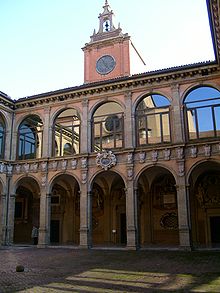 |
| University of Bologna, Italy and Europe's oldest university, founded in 1088 |
- Post‐secondary non tertiary education offered through: post‐qualification and post‐ diploma vocational courses organized by the Regions; Higher technical education and training courses (IFTS).
- Higher education offered by universities and the High level arts and music education system (Afam). Higher education is organised in first, second and third levels according to the Bologna structure.
Education is compulsory for 10 years, from 6 to 16 years of age, and covers the eight‐year first
cycle of education (5 years of primary school and 3 years of lower secondary school) and the
first two years of the second cycle (DM 139/2007). After completion of the first cycle of
education, the last two years of compulsory education (from 14 to 16 years of age) can be
accomplished either in State upper secondary schools (licei, technical institutes and vocational
institutes), or through the three‐year vocational education and training courses, falling under
the competence of the Regions (law 133/2008).
In addition, all have the right/duty (diritto/dovere) to education and training for at least 12 years
in the education system or, anyhow, until they have obtained a three‐year vocational
qualification within 18 years of age (law 53/2003).
Finally, 15‐year olds can attend the last year of compulsory education also through the
apprenticeship, previous specific agreement signed by the Regions, the Ministry of labour, the
Ministry of education and trade unions (law 183/2010).
 |
| STRUCTURE OF THE ITALIAN EDUCATION SYSTEM |
Compulsory education refers to both enrolment and attendance. It can be accomplished either
in a State and a paritaria school and also, at certain conditions, though parental education and
merely private schools; regional three‐year vocational training courses are offered by the
relevant training agencies. Parents or caregivers are responsible for the accomplishment of
compulsory education, while supervision on the fulfilment of compulsory education falls under
the responsibilities of local authorities where pupils reside and school heads of the schools
pupils are enrolled in.
Once compulsory schooling has been accomplished, pupils who don’t prosecute their studies
receive a certification attesting compulsory education fulfilment and competencies acquired;
these latter constitute formative credits for the attainment of any professional qualification.
Access to both university and Afam tertiary education is reserved for students who passed the
State exam at the end of upper secondary school. Yet, specific conditions for the admission are
under the responsibility of the Ministry of education, University and Research (MIUR) or of
each single university and Afam sector.
 |
| The first italian graduates from the HERMES Dual degree program between Ca Foscari and EM Strasbourg |

The three‐year vocational qualification, as well as the four‐year vocational diploma, both
obtained at completion of regional vocational training courses, allow access to regional second
level vocational training, which can be access also with an upper secondary education leaving
certificate. This latter certificate also grants admission to Higher technical education and
training courses (IFTS).
The education system in Italy might seem a bit complex at first, but over time, Italy has been producing some of the finest graduates in the world.

First things first, great job with the article Ushoshi. You've done a really great job. It's intriguing that you chose the educational system to do your analysis on! The one thing that caught on my mind was the compulsory schooling. I think that's something we need very much in our country. I guess, comparing this with our educational system, there are a lot of similarities in the basic under lying idea or educational structure. It is the regulations and implementation that has made a world of difference. This is just my opinion, I might have gotten it wrong somewhere, I hope I haven't!
ReplyDeleteThanks a lot Shreya. I agree on what you have said: what I personally too feel marks the difference is that the way they have arranged the system. There's a lot of things that our country should learn from them when it comes to education. I again agree with you about compulsory education. Every child in the country deserves the right to learn and get educated and I think Italy is doing a great job in giving the children this right.
ReplyDeleteI must say MIUR is doing a great job in their country and we, the youth of our generation, must try to bring about a change in the field of education. I hope we bring about a revolutionary change in the near future and make ours a brighter and better country.